


“We don’t want to seem unfriendly, but . . .”
How often have we heard that phrase?
When they call to review their fencing options, many people say they want privacy but don’t want the neighbors to feel it’s personal. If you’ve had that thought, rest assured, it is a very common and understandable one. The desire to relax inside your property, to experience your space as a place of refuge, and to eliminate unsightly images are all reasonable goals. Fencing can be an excellent answer to those needs.
People sometimes feel that only a tall, solid fence will give them what they want. Before you reach that conclusion, it is worthwhile to consider the statement your fence will make in the landscape and the various ways of creating the right privacy fence for your situation. In many cases, selecting a design that increases privacy and maintains a friendly feeling is possible.
What Type of Privacy?
Fencing can meet different types of privacy and screening needs, and let’s acknowledge here that not all of them are friendly. We often hear about several different privacy goals:
- Barriers to physical entry: This type of fence seeks to exclude intruders and is generally not in the friendly fencing category. A typical barrier-to-entry scenario occurs in a lumber yard, where goods are protected by a high fence that is difficult to cross. Typical residential scenarios involve deer fencing or fencing that excludes roaming dogs.
- Screening out sights: Fencing is often used to block undesirable images inside or outside the property boundaries. For instance, people hide garbage cans, propane tanks, utility poles, gas stations, or industrial sites at the edges of residential or retail zones. Many people use a tall, solid fence to screen views of a busy street or a parking lot.
- Creating privacy: Even when we feel good about our neighbors and neighborhoods, it can be unsettling to feel visible. We don’t like to feel we can be seen by anyone passing by, particularly when we can’t see them. This type of privacy can be most easily addressed with “friendly fences.”
Principles of Friendly Fences
Several factors determine the overall visual statement made by a fence.
Local surroundings: A village, a busy state road, or a retail district call for different privacy fence approaches. Although local regulations dictate the maximum height of the fence (and sometimes the style), many other factors need to be considered in light of unwritten expectations by neighbors in the local surroundings. For instance, a tall, solid fence may not get much notice along a busy through-road. However, the same fence might evoke negative reactions in a village setting.
Height and distance of the fence: The closer the fence is to the viewer, the more views are blocked. This can be a good thing for the fence builder, but jarring to those whose views are blocked. When planning the placement of your fence, use this factor to determine whether the height and distance of the fence will create negative impressions. This principle is also helpful if you wish to block an image within your property boundaries, so that you can’t see the local gas station from where you relax on a porch or patio.
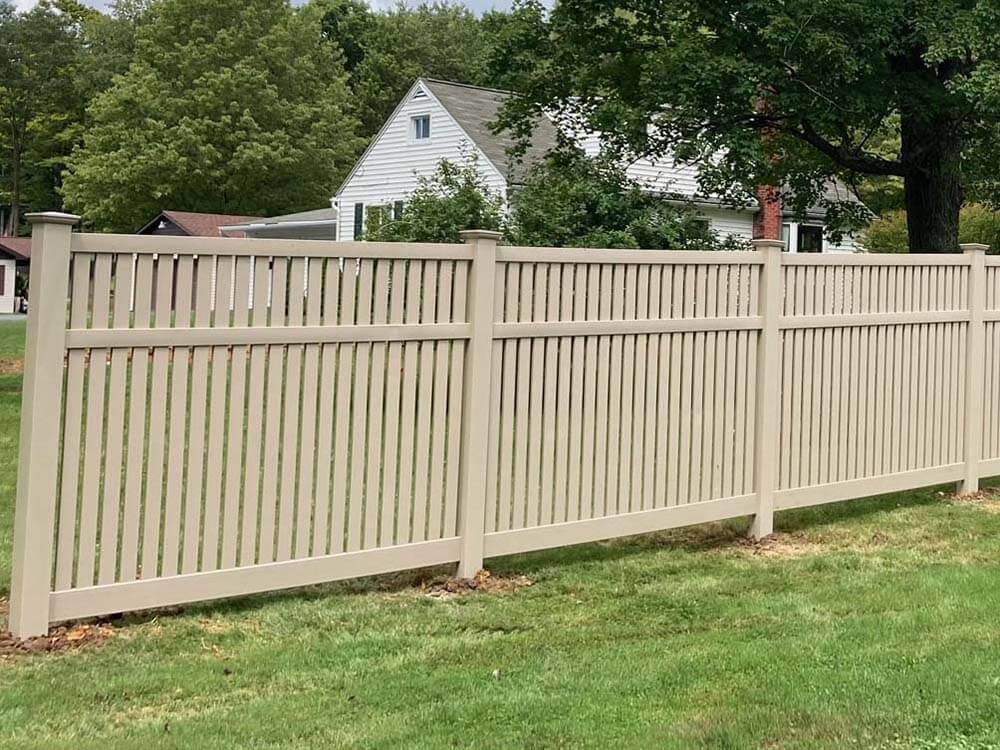
Materials: Many materials will help deflect attention from a space while not creating a solid barrier. Open lattices and curved lines in a fence are key to making the impression of a friendly boundary. They have a lighter touch on the landscape than a solid fence.
Context is important in fence selection. A quiet village street may require a different style and statement than an area along a busy state road.
You can create open areas using multiple fence heights while achieving maximum privacy where needed.
The friendliness of a fence is generally increased when lightly intermingled with shrubs and trees, both evergreen and deciduous. Fences lined by well-tended plantings have a softer appearance.
If you don’t want to seem unfriendly but wish to increase your comfort and sense of privacy in a location, consider the principles of friendly fences. The fence design that results may seem less forbidding to neighbors and passersby and may also be more pleasing to you. Let’s look at some of the most popular privacy and neighbor-friendly fence styles.
Full Privacy Fence
A full privacy fence creates complete seclusion for your property, with popular styles including solid wood panels, vinyl privacy fences, and composite options that block all visibility.
Semi-Privacy Fence
A semi-privacy fence offers airflow and partial visibility, with popular styles including shadowbox, lattice-top, and spaced-picket designs that balance openness with privacy.
Decorative Fences
Decorative fences add style and character to your property while providing structure and definition. Popular options include ornamental aluminum, custom wood designs, and vinyl accents that enhance curb appeal without sacrificing durability.
The right fence doesn’t just define boundaries; it creates comfort, enhances curb appeal, and keeps relationships with neighbors warm. Choosing a design that balances seclusion with friendliness allows you to enjoy peace of mind while maintaining a welcoming presence in your community.
